
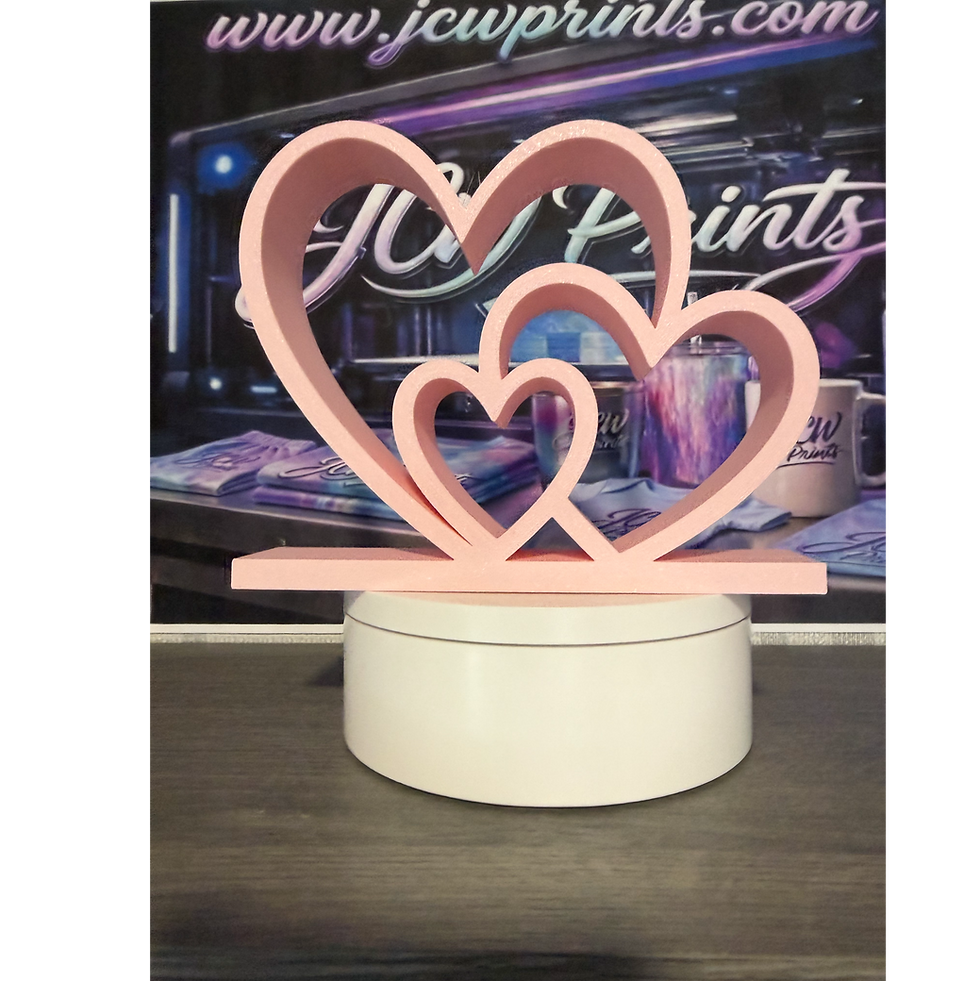
3D Printing




TERMS & CONDITIONS!
JCW Prints
By placing an order with us, you agree to the following terms and conditions. Please read them carefully before purchasing.
PRODUCTS & PERSONALISATION
We supply a range of seasonal and all-year-round items, including:
• Personalised and non-personalised sublimation-printed hot/cold tumblers
• UV DTF wrapped snow globe tumblers
• Sublimation mugs
• UV DTF wraps
• Clothing
• 3D printed items
• Gift certificates and personalised letters
Important Safety Note
Some items contain small parts and are not suitable for children under 5 years old. These will be clearly marked where applicable. Please keep out of reach of young children to avoid choking hazards.
For 3D printed items: Small components, loose parts, or fragile structures may also pose a choking risk. 3D printed items are not toys unless explicitly stated and should be kept away from young children unless supervised.
Material & Finish Variations
In addition to colour differences noted below:
Handmade Items: Many of our products are made and finished by hand. As such, they may have minor imperfections, slight irregularities, small marks, or subtle variations in shape, size, or finish. These are normal characteristics of handcrafted work and are not considered defects.
3D printed items may have minor surface lines, layer marks, slight dimensional variations, or texture differences — these are normal characteristics of the 3D printing process and are not considered defects.
Colour Variations
Colours may appear slightly different between product photos and the finished item. This is due to differences in screen displays, lighting conditions during photography, and printing or manufacturing processes. We do not accept responsibility for minor colour variations.
PERSONALISATION, DESIGN & ACCURACY
• Spelling & Details: You are fully responsible for providing correct spelling, names, dates, measurements, dimensions, and any other information or specifications required for personalisation. Please double-check all details before submitting your order. We cannot be held responsible for errors or mistakes caused by incorrect information provided by you.
REFUNDS, RETURNS & DAMAGES
• Personalised & Custom Items: This includes personalised printed goods and custom 3D printed items. Due to their custom nature, we do not offer refunds or exchanges unless they arrive faulty, damaged, or not as described. Minor cosmetic differences, layer lines, slight dimensional variations, or characteristics of handmade work as outlined above are not eligible for return.
• Faulty or Damaged Goods: If your item arrives faulty or damaged, you must contact us within 24 hours of delivery to report the issue.
• How to Report: Send an email to jcwprints@gmail.com including your order number, clear photos showing the fault or damage, and a brief description. We will respond as soon as possible to arrange a replacement or refund.
ORDER PROCESSING
• Production times vary depending on the item, complexity, and order volume. 3D printed items may require longer lead times due to print time, material selection, and post-processing needs. Estimated times will be provided at checkout or on your confirmation email.• We aim to process orders as quickly as possible, but delays may occasionally occur due to high demand, supply issues, or technical factors in 3D printing or production — we will notify you if this happens.
CONTACT INFORMATION
For all enquiries, reports of damage, or order updates, please email:
Please include your order number in all communications.
These terms and conditions are subject to change without notice. The version applicable to your order will be the one in place at the time of purchase.